

NEWS November 10, 2021
The Crafts College in Herning
The college has been created for students in the skilled trades. It provides room both for private life and for new ideas and social relationships to emerge. The buildings themselves are a kind of “textbook” of craftsmanship, demonstrating sound solutions in terms of construction, workmanship, and architecture.
The Crafts College forms the setting for a group of people’s lives, with everything that entails. Our competition proposal ensures that the 84 residents experience varying degrees of intimacy and homeliness, ranging from the most private spaces to the more outward-facing activities in the workshop and encounters with the outside world.
The aim has been to create a place that supports the development of the important skilled trades. At the same time, it shows how good craftsmanship can result in a building that actively contributes to the green transition, with a sustainability profile that is both tangible and measurable.
Where nature meets industry
In the skilled trades, nature’s materials are processed and refined, and for that reason it feels entirely right that the Crafts College is located in the transition zone between the beautiful natural setting of Lillelund Meadow Park and an industrial area. The overall concept, with three wings forming an inner courtyard, gives the college a strong identity that evokes both industrial facilities and the traditional farmsteads seen in the region.
Three roofs, three landscapes
The three large roofs meet three different landscapes, with a close connection between the functions of the buildings and the landscape immediately outside.
The large workshop almost becomes a new family member in the industrial town around Herningsholm Vocational School & Upper Secondary School. The common house to the west merges with the large open meadow, while the more private and intimate “garden” to the south lies adjacent to the residences. The inner courtyard ties together all of the college’s functions and provides the setting for daily work in the workshop, communal dining, and morning coffee from the shared kitchens.
Passive design strategies
The large roofs create robustness. Generous spatial qualities and ceiling heights ensure that the college functions well now. They also make it possible in the future to insert additional floor decks and create “rooms within rooms.” A central part of our sustainability strategy has been to use the building’s design to maximize the project’s passive potential to create a good indoor climate and reduce resource and energy consumption. We have worked with three focus areas:
Reducing the building’s resource and energy consumption by creating building depths, floor heights, and glazed areas with strong potential for daylight, natural ventilation, and solar heat gain.
Optimizing the building’s technical performance through roof pitches and overhangs that balance solar heat gain in winter and passive solar shading in summer.
Producing energy and resources on site through the pitch of the roof, which creates favourable conditions for energy production via photovoltaic panels and solar heating, as well as for rainwater harvesting and treatment.
The path toward a 70% CO2 reduction
The college has been conceived in natural materials of high quality and long lifespan, with a focus on timber as the primary material. The results of the life cycle assessment show that the project’s total climate impact is estimated at 8.24 kg CO2 equivalent per m² per year, which is a lower climate impact than both the reference value in the DGNB certification and the climate impact requirement for new construction that came into force in 2023.
Type
Student housing
Client
BRF Foundation
Address
Herning, Denmark
Area
5,973 m², landscape 2,125 m²
Engineer
Aaen Engineering (Sustainability)
Jørgen Nielsen Consulting Engineers
Sinuz
Landscape
BOGL
Visualizations
ArtefactoryLAB
Background photography
Hampus Berndtson
Year
Competition proposal 2021
(Not won)

The student housing complex connects the industrial area with nature. Its large roofs draw horizontal lines that frame the beautiful, flat meadow landscape. This gesture gives the residence a powerful identity, evoking both industrial facilities and the traditional three-winged farmsteads found in the region.

The site is located on the edge between the low-lying meadow area and the ridge where HEG (Herningsholm Vocational School & Gymnasium) is situated.

The landscape forms part of the blue-green ring around Herning, connecting Fuglsang Lake with the large open landscape north of the city.

Landscape reading; the high sky, the light between the clouds, and the flat landscape. Watercolour sketch, April 2021.

Katrinedal Teglværk, Silkeborg, 1911

Translation of the landscape reading into building typology. Large roofs with slits of light. Watercolour sketch, April 2021.


The courtyard is the student residence’s main communal space. It is a robust space that can withstand wear and tear, providing the setting for daily work in the workshop, shared meals, and morning coffee from the common kitchens. The permeable gravel surface creates a unifying, flexible, and bright courtyard. Adjacent to the workshop, we have placed a concrete area that can be used for outdoor work. The local microclimate determines the layout of the courtyard: where the sun reaches, the outdoor space is kept open, while groups of smaller, multi-stemmed trees are planted where the wind enters through the three gate openings.
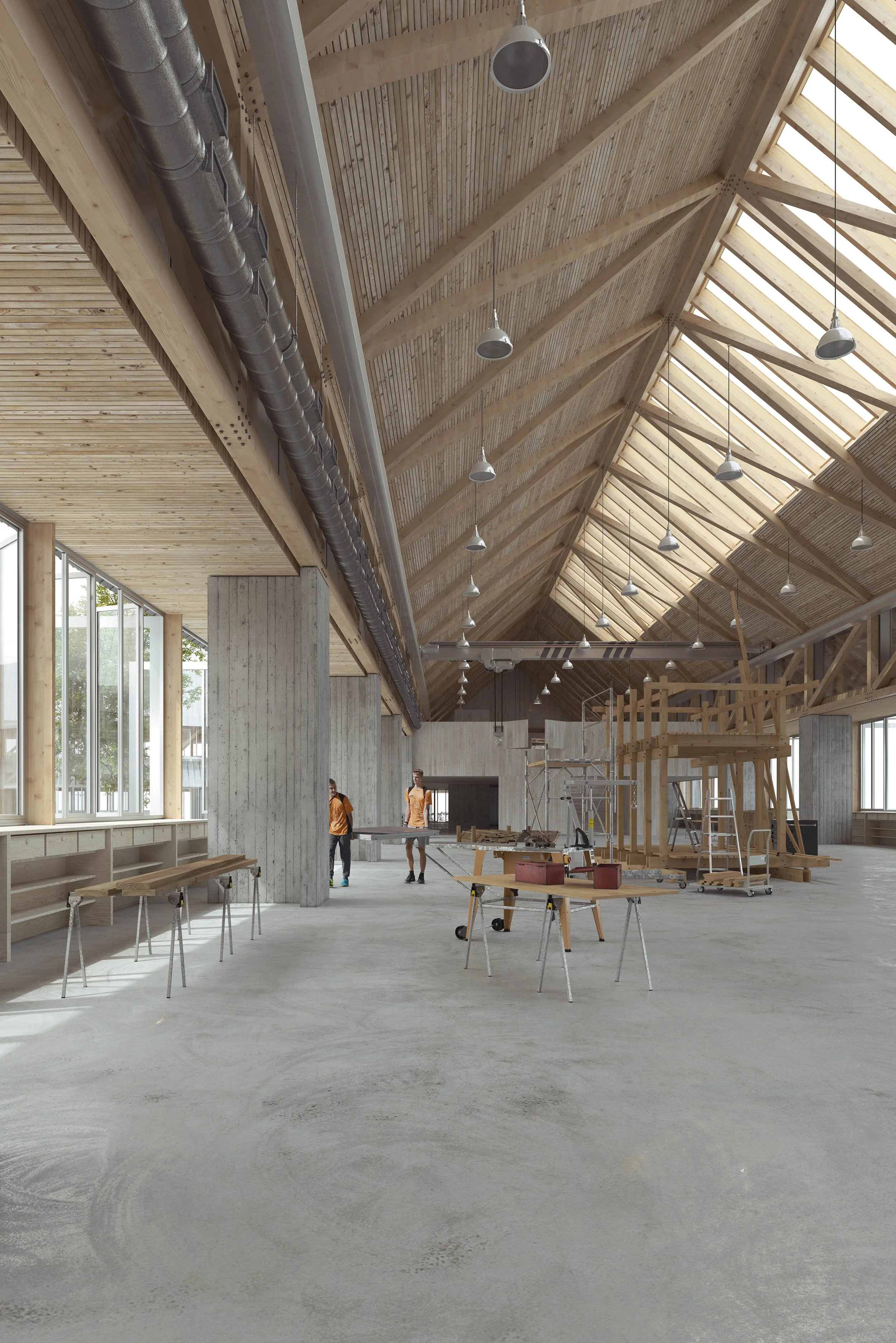
Værkstedet er ét stort rum. Herfra er der god adgang til porten mod fælleshuset, ankomstområdet, gården og udeområderne. Store porte gør, at materialer og mock-ups let kan transporteres ind og ud på både palleløftere og i biler. Nicherne langs siderne er til specialfunktioner. Det store ovenlys mod nordøst giver et smukt morgenlys og et praktisk, blødt lys til de travle timer midt på dagen.

The workshop is one large space. From here, there is easy access to the gate facing the communal house, the arrival area, the courtyard, and the outdoor areas. Large doors make it easy to transport materials and mock-ups in and out, both by pallet truck and by car. The niches along the sides are intended for specialist functions. The large skylight facing northeast provides beautiful morning light and practical, soft light during the busy hours in the middle of the day.

From the residences, there is direct access to the south-facing garden. It is an intimate and private space, sheltered from the wind and with good sun conditions. The planting consists of fruit trees and shrubs that create smaller spaces and niches. The private garden is balanced by the courtyard, where the larger community can unfold.

The structural principles have been chosen to ensure maximum flexibility: the size and number of rooms can be changed over time without intervening in the load-bearing structures. The main structural elements are visible and form part of the architectural motif.

The load-bearing structure is made of timber and consists of longitudinal lattice girders running parallel to the façade, and three-hinged frames at every second or third module. These are supported by fixed-base concrete columns positioned in the façades.

Main structure: Glulam frame construction Primary load-bearing columns at ground level: In-situ concrete Ground slab: Cast concrete slab with heating, rigid insulation incl. radon barrier Façades: Steel folding windows with Janisol profiles Internal load-bearing floor decks: Timber floors; load-bearing deck: Gyproc TCA steel floor deck incl. mineral wool Internal partition walls: Timber frame construction or CLT elements Roof: Metal cladding

In the residential building, the different housing types are mixed and organised around central neighbourhood spaces, which serve as both outdoor and indoor gathering places. They share common stairwells and communal kitchens on the ground floor.

We believe that a sense of home and security is the prerequisite for residents having the capacity to participate honestly and openly in the community. Up under the roof, one finds the most private spaces. The homes have lofts that can be furnished as sleeping areas or reading nooks.

